In This issue #1 We Highlight 4 Artists And Some Significant Works
Join the Conversation!!!

We will Feature Up to 4 Albums from Artists representative of a range of the many sub-genres. We Hope to encourage Listeners of all tastes and passions. So Get your Headphones on and consider discussing the musical offering and sharing your views with like-minded peers.
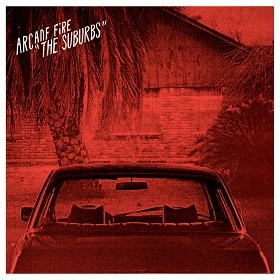
The Suburbs is the critically acclaimed third studio album the indie rock band Arcade Fire, released in August 2010. Inspired by band members Win and Will Butler’s childhood experiences growing up in suburban Houston, Texas, the album serves as a poignant, universal exploration of nostalgia, youth, private disappointments, and the loss of innocence.The album ‘Suburbs’ reflects on youth in corporate suburbs. The tracks critique trendy areas like Williamsburg in New York and Hoxton in London. where people try to show off their uniqueness by dressing similarly and listening to the same music. Spanning 16 tracks (including brief interludes and multi-part songs), the record ranges from folk-leaning piano ballads to glittering synth-pop anthems. Essential Standout Tracks:“Suburban War”: A sweeping, melancholic folk-rock ballad dealing with changing friendships and growing pains. “The Suburbs”: The title track sets the album’s bittersweet tone with acoustic guitars and a reflective look at youth and lost innocence. “Sprawl II (Mountains Beyond Mountains)”: A vibrant, synth-driven anthem led by Régine Chassagne that builds into an emotional peak about escaping suburban isolation.“Ready to Start”: A driving, guitar-heavy indie rock track featuring urgent rhythms and themes of modern disillusionment. “We Used to Wait”: An interactive, piano-anchored song that contrasts the slow pace of the past with fast modern communication. The album fades out with a reprise of ‘The Suburbs (continued)’; buzzing violins instigate the winding down from the journey before a dusky end, leaving you refreshed at the same time as wanting more.
.
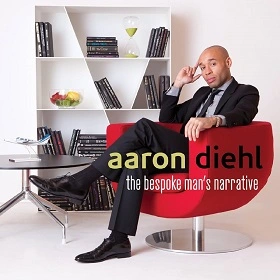
The Bespoke Man’s Narrative is the critically acclaimed studio debut album, released in 2013 through Mack Avenue Records. The title reflecting Diehl’s approach of specifically tailoring his musical arrangements to the unique strengths and personalities of his quartet. The album showcases a highly polished blend of historic jazz roots, chamber music sensibilities, and contemporary precision. The Bespoke Man’s Narrative is a well-balanced album of fresh originals and stirring arrangements of standards. He is ably supported by Gifted Musicians Vibraphonist Warren wolf, Drummer Rodney Green and David Wong. .Key Tracks and Highlights:“Le Tombeau de Couperin (III. Forlane)”: An ambitious, nearly 11-minute classical adaptation of Maurice Ravel’s work that bridges jazz and impressionist chamber music. “Generation Y”: An exhilarating, straight-ahead swing opener showcasing high-energy interplay and a standout, galloping solo by vibraphonist Warren Wolf. “Blue Nude”: A slow-moving minor blues composition featuring spacious, relaxed drumming by Rodney Green that highlights Diehl’s refined piano command. “Stop and Go”: A lightning-fast, energetic track driven by Diehl’s dazzling rapid-fire piano effects and Wolf’s solid tempo. “Moonlight in Vermont”: A clever reworking of the classic standard that updates the ballad with an up-tempo feel and nods to the stylistic approach of Ahmad Jamal. “Single Petal of a Rose”: A gorgeous, haunting solo piano interpretation of the Duke Ellington composition.
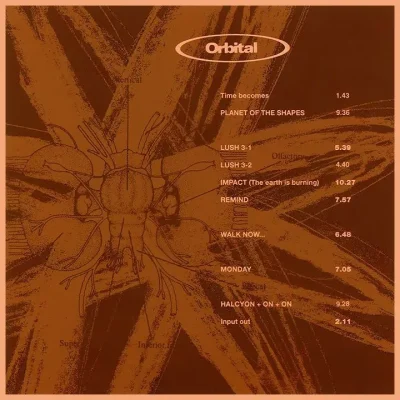
Orbital (also known as the Brown Album) is the second studio album by English electronic music duo Orbital. The duo aimed to make more atmospheric music than the dance raves of their first album. Released in May 1993, the album is widely considered a landmark masterpiece that helped transition UK techno from raw rave novelty into sophisticated, album-length listening music. Standout Tracks: Remind: A hypnotic, driving composition that acts as a crucial anchor in the album’s immersive mid-section. Halcyon + On + On: An iconic electronic music staple featuring a dreamy progression, ethereal atmosphere, and a haunting vocal sample from Opus III’s “It’s a Fine Day”. Impact (The Earth Is Burning): A sweeping, ten-minute centerpiece known for its looping synth lines, rising tension, and seamless flow into subsequent tracks. Lush 3-1 & Lush 3-2: A dynamic two-part journey blending complex melodic flute and guitar themes with driving techno rhythms.
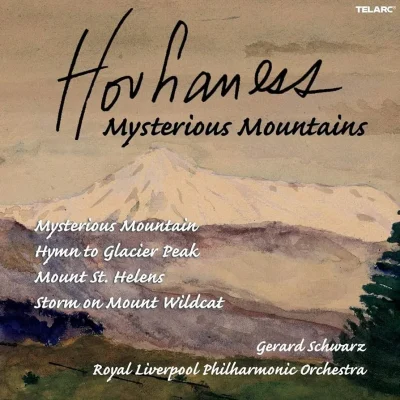
Symphony No. 2, Op. 132, “Mysterious Mountain” is a three-movement orchestral masterpiece. Musically, the symphony is renowned for bypassing the mid-century avant-garde obsession with atonality and serialism, opting instead for a deeply meditative, modal, and luminous atmosphere that blends Western hymn-like textures with Renaissance polyphony and Eastern rhythms. The work is structured into three continuous movements, shifting seamlessly between archaic mysticism and brilliant contrapuntal energy: I. Andante con moto: A monothematic movement that opens with a calm, heavenly hymn in the Phrygian mode. The lyrical lines flow gently through the woodwinds, beautifully decorated by shimmering celesta arabesques and harp ripples. II. Double fugue (Moderato maestoso; allegro vivo): A structural marvel. It begins with a slow, vocal-style subject reminiscent of a Renaissance motet. This is shattered by a rapid, restless string melody. The two distinct subjects are eventually combined in a massive, driving climax. III. Andante espressivo: Initiated by a solemn, mysterious chant by muted horns and trombones. The movement swells into a “giant wave” built Indian raga-like before receding into an ethereal, glowing conclusion.
Symphony No. 66, Op. 428, subtitled Hymn to Glacier Peak, is a three-movement orchestral composition. The symphony is a tribute to Glacier Peak, a stratovolcano in Washington’s Cascade Range that Hovhaness could see directly from his study window in Seattle. The symphony has an average duration of around 18 to 19 minutes and is divided into three distinct movements: I. Andante maestoso, this movement opens with a solemn string hymn enhanced by the trumpet and trombone. A central, lively dance-like section features canonic flutes over a rhythmic timpani line before returning to the majestic opening hymn and closing with a heavenly coda accompanied by bells. II. Love Song to Hinako (Andante espressivo) A tender, monothematic movement dedicated to the composer’s wife, Hinako Fujihara. It highlights a lyrical oboe solo singing softly over pizzicato strings and finishes with an ascending harp scale. III. Prelude and Fugue (Largo maestoso) A very free-form movement that blends Hovhaness’s trademark neo-Renaissance contrapuntal mastery with eastern modalities. It begins with a solemn orchestral statement, moves into a quiet clarinet solo with timpani tremolos, and erupts into a vigorous, canonic string fugue before building to a triumphant brass-driven finale.
Storm on Mount Wildcat, Op. 2 No. 2, is a brief symphonic tone poem composed when he was just 20 years old, it holds a significant historical place as his earliest acknowledged orchestral work. the piece focuses more on the sheer natural beauty and spiritual majesty of the storm.
Symphony No. 50, Op. 360, “Mount St. Helens” is a three-movement orchestral masterpiece directly inspired by the catastrophic 1980 eruption of Mount St. Helens, which Hovhaness vividly witnessed from his home in Seattle. The work spans roughly 25 minutes and is structured into three movements: I. Andante, grazioso: This movement focuses on the majestic mountain itself before the disaster. It portrays a serene, pristine landscape using Hovhaness’ trademark long, Eastern-influenced melodies and modal hymn-like textures. II. Spirit Lake (Allegro): A playful and delicate movement depicting the idyllic lake at the foot of the mountain. It employs interlocking woodwind patterns and glockenspiel to capture the water’s surface reflecting the mountain silhouette. III. Volcano (Adagio – Allegro – Adagio): This movement illustrates the violent 1980 eruption that blew off the upper third of the mountain and buried Spirit Lake. It features an awesome, thunderous orchestral outburst—utilising massive, chaotic percussion and brass glissandi to simulate the explosion—before resolving into a triumphant, hymn-like hymn of creation.
It is helpful to research the artist, using sources like Wikipedia , Music Magazine Reviews (Pitchfork, Rolling stone, NME etc.,) Artist Websites, etc…
A synopsis of the life and music of this Issue’s featured artists appears below.
This Week’s Artists
ARCADE FIRE
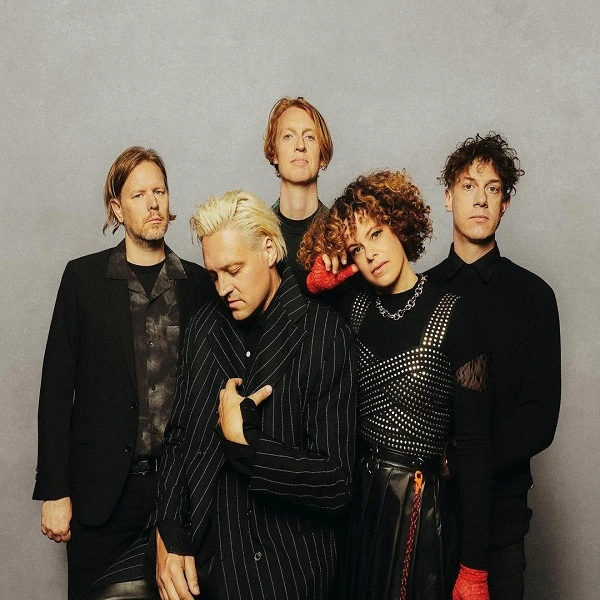
Arcade Fire is a Canadian indie rock band from Montreal, Quebec. Members include husband and wife Win Butler and Régine Chassagne. alongside Richard Reed Parry, Tim Kingsbury, and Jeremy Gara. Notable touring members include violinists Sarah Neufeld and Owen Pallett.The band came to prominence in 2004 with the release of their critically acclaimed debut album Funeral. Their second studio album, Neon Bible, won them the 2008 Meteor Music Award and the 2008 Juno Award. Their third studio album, The Suburbs, was released in 2010 to critical acclaim and commercial success. Arcade Fire has released seven studio albums, three extended plays and twenty-four singles. Arcade Fire are known for their enthralling live performances. They use a large number of musical instruments In addition to guitar, drums, and bass guitar. members play piano, violin, viola, cello, double bass, xylophone, keyboard, French horn, accordion and harp.The promise showed by the band gained them a record contract with independent record label Merge Records. Their sixth studio album, ‘WE’, which was partly inspired by Yevgeny Zamyatin’s 1924 dystopian novel of the same name. marked the band’s last record with Will Butler (the younger brother of Arcade Fire frontman Win Butler). who parted ways with the group to follow a Solo Career. Win Butler was accused of sexual misconduct by several people in 2022. In a statement to Pitchfork, a representative for Butler acknowledged he had sexual interactions with each of them, but said they were not initiated by him and were consensual. Chassagne supported his statements. Arcade Fire returned in 2025 with their seventh album
ORBITAL
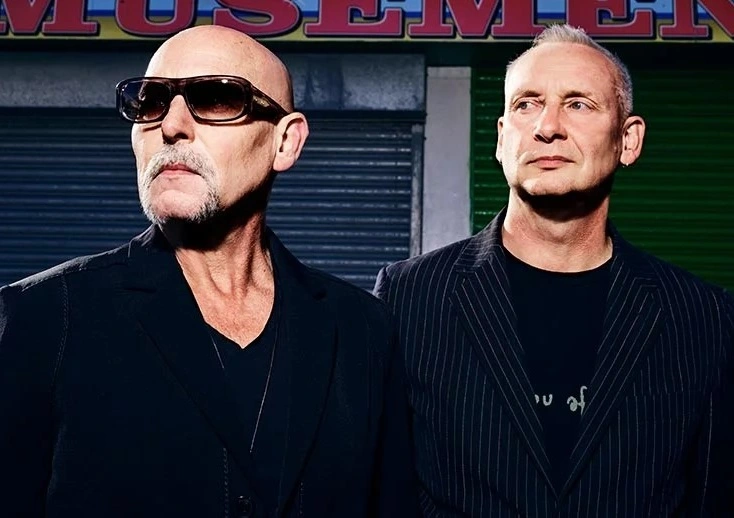
Orbital are brothers Phil and Paul Hartnoll. Raised in Sevenoaks, Kent, they first worked together as bricklayers for their father’s business, but started recording music in 1987. Their first single, Chime, entered the Top 20 in 1990. One of the biggest British dance acts of the decade. their crossover fusion of underground and stadium electronic music found a vibrant cultural Scene. Paul in a Guardian interview, recalls – “When we were bricklayers, I’d bring my tape recorder to work …….. On our lunchbreaks we’d dream about what it might be like to be in the Cocteau Twins. Eventually, Phil bought a drum machine, I played the guitar, and we began trying to make Cabaret Voltaire-type stuff.Once my music started taking off, he wanted to join in, too, so we decided to make a band. When it comes to our creative relationship, he’s the hare and I’m the tortoise. I’m the writer and do all the hard graft, while he runs around the background, saying: “That’s excellent!” or, “That’s too complicated!” All of the splits in Orbital have been initiated by me.”
Their first single, 1989’s “Chime”, became a huge rave hit. Not long afterwards, Orbital started gaining fans outside the dance scene. Due to the strength of their live shows and an emphasis on albums as cohesive units rather than a tracklist. Their output through the ’90s is commonly cited as among the best of the UK’s techno scene. Throughout their career, Orbital have incorporated political and environmental commentary into their music. . Orbital called it quits in 2004. Orbital briefly reunited for a string of live shows. In 2011 they returned to the studio to work on a new album.
The result, 2012’s Wonky, The album was well-received, both by the critics and the fans. In 2014, they disbanded again, but with the promise that neither of them intended to stop making music yet. In summer 2017, they reunited again. They went on to play more live shows and put out a new single. a new studio album was released the following year. The Orbital Discography consists of ten studio albums, three original score albums, three live/session albums, seven compilation albums, two DJ-mix albums, four extended plays, and eighteen singles
ALAN HOVHANESS
He was one of the most prolific 20th-century composers. his official catalogue comprised 67 numbered symphonies and 434 opus numbers. The true tally is well over 500 surviving works, since many opus numbers comprise two or more distinct works. He was born Alan Vaness Chakmakjian to an Armenian father and an American Mother (of Scottish descent). When he was five, his family moved from Somerville to Arlington, Massachusetts. A Hovhaness family neighbour said his mother had insisted on moving from Somerville because of discrimination against Armenians. in 1931, the composer changed his surname to Hovaness. later adding an ‘h’ after the ‘v’ around 1942, and so becoming Hovhaness. Hovhaness’s parents soon supported their son’s precocious composing. By age 14 he decided to devote himself to composition. He composed two operas during his teenage years. The composer Roger Sessions took an interest in his music during this time. He went on To Study with Leo Rich Lewis at Tufts. Later, under Frederick Converse at the New England Conservatory of Music . In 1932, he won the Conservatory’s Samuel Endicott prize for composition with his Sunset Symphony. In July 1934, Hovhaness travelled with his first wife, Martha Mott Davis, to Finland. There he met Jean Sibelius, whose music he had greatly admired since childhood. His early compositions were thoroughly Western. the influences of Eastern musical styles became more evident after he attended a master Class of Bohuslav Martinu. From 1959 through 1963 Hovhaness conducted a series of research trips to India, Hawaii, Japan, and South Korea. investigating the ancient traditional music of these nations, and eventually integrating elements of these into his own compositions. In the mid-1960s he spent several summers touring Europe, living and working much of the time in Switzerland. From the 1970s onwards his style became less overtly Eastern. He was A vocal critic of musical snobbishness. in reaction to criticism by Aaron Copland and Leonard Bernstein he destroyed some early work, which he later regretted. Hovhaness’s best music reveals a unique and thoroughly convincing assimilation of highly disparate traditions. many 20th century composers flirted with such exotica. but in Hovhaness we find it was more than mere flirtation. Vocal music by Hovhaness includes accompanied and unaccompanied choral settings of predominantly religious texts.
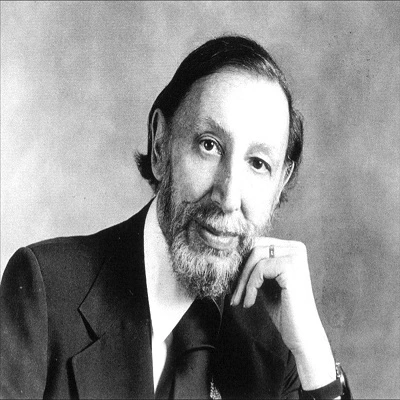
A review by David Hurwitz in Classics Today “For me anyway, there’s something disarming about his childlike joy in consonant harmony, in the fluidity of his fugal writing, and his utter unconsciousness of the fact that his melodies often tread dangerously close to kitsch. Say what you will, his music is unfailingly honest. It is what it is. There are also moments where it achieves an astonishing, passionate intensity.“
AARON DIEHL
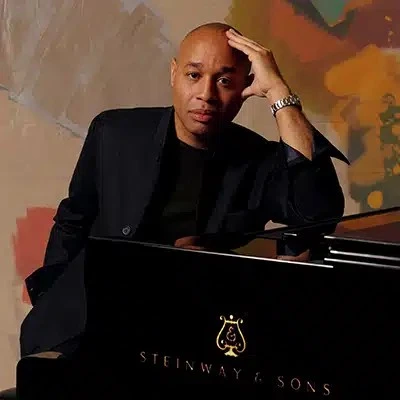
Diehl was born in Columbus, Ohio. he grew up listening to his grandfather, pianist and trombonist Arthur Baskerville. Diehl began studying classically at age 7 and discovered his passion for jazz music when attending Interlochen Summer Camp. There, he met piano prodigy Eldar Djangirov, who impressed Diehl through his enthusiasm for Oscar Peterson and Art Tatum. His family nurtured Diehl’s undeniable musical talents from a young age. in 2002, a 16-year-old Diehl competed in Jazz at Lincoln Center’s Essentially Ellington competition, where he placed as a finalist. It was there that he attracted the attention of Wynton Marsalis, who invited Diehl to join his European tour. He Studied at Julliard under the direction of Kenny Barron. In 2011 Diehl was awarded the American Pianists Association’s Cole Porter Fellowship. Diehl has been a Steinway Artist since 2016. Philadelphia Inquirer exclaimed that “there’s an entire world of jazz in Aaron Diehl’s playing…he makes the case that jazz is not one style or genre but many, gliding gorgeously among decades of artistic influences.” “traditional jazz sound with a sophisticated contemporary spin” (The Guardian). “Diehl has built his reputation on an elegant pianism outside the contemporary mainstream…upholds a traditional framework while crisply demolishing the usual notions of conservatism.”(New York Times)
Sound quality is important and the better online Streaming services will offer superior sound quality. As always, We do encourage you to purchase Favoured albums from good online or High street record stores.
Arcade Fire – The Suburbs – Label : Merge RecordsIntroduction
Aaron Diehl – The Bespoke Man’s Narrative – Label : Mack Avenue Records
Orbital (also known as Orbital 2 or the Brown Album) – Label : FRRR Records
Alan Hovhaness – Mysterious Mountains – Label : Telarc – 80604
In further issues we will continue to bring you the music of popular genres to listen, review and evaluate.
Issue #2 (coming soon) features T. Rex, Dead Can Dance, Joshua Redman and Edvard Grieg