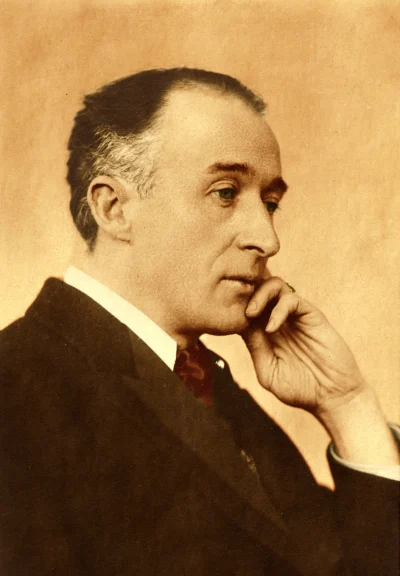
Frederick Delius
Delius was born in Bradford in Yorkshire. He was the second of four sons – there were also ten daughters – born to Julius Delius (1822–1901) and his wife Elise Pauline, (1838–1929). Julius moved to England to further his career as a wool merchant, and became a naturalised British subject in 1850. He married Elise in 1856.The Delius household was musical; famous musicians such as Joseph Joachim and Carlo Alfredo Piatti were guests, and played for the family. Despite his German parentage, the young Fritz was drawn to the music of Chopin and Grieg rather than the Austro-German music of Mozart and Beethoven, a preference that endured all his life. The young Delius was first taught the violin by Rudolph Bauerkeller of the Hallé Orchestra, and had more advanced studies under George Haddock of Leeds. Although Delius achieved enough skill as a violinist to set up as a violin teacher in later years, his chief musical joy was to improvise at the piano. Julius Delius assumed that his son would play a part in the family wool business. Julius Delius soon recognised that there was no prospect that his son would succeed in the family business, but he remained opposed to music as a profession, and instead sent him to America to manage an orange plantation. Delius was in Florida from the spring of 1884 to the autumn of 1885. He continued to be engrossed in music, and in Jacksonville he met Thomas Ward, who became his teacher in counterpoint and composition. While in Florida, Delius had his first composition published, a polka for piano called Zum Carnival. In 1886, Julius Delius finally agreed to allow his son to pursue a musical career, and paid for him to study music formally. Delius returned to Europe and enrolled at the conservatoire in Leipzig, Germany. Important to Delius’s development was meeting the composer Edvard Grieg in Leipzig. Grieg, recognised Delius’s potential. After leaving Leipzig in 1888, Delius moved to Paris where his uncle, Theodore, took him under his wing and looked after him socially and financially. Delius’s Paris years were musically productive. It is generally believed that during this period he contracted the syphilis that caused the collapse of his health in later years. In 1897, Delius met the German artist Jelka Rosen, who later became his wife. They married in 1903 and, apart from a short period when the area was threatened by the advancing German army during the First World War, Delius lived in Grez for the rest of his life. By 1907, thanks to performances of his works in many German cities, Delius was, as Thomas Beecham said, “floating safely on a wave of prosperity which increased as the year went on”. In 1909, Beecham conducted the first complete performance of A Mass of Life, the largest and most ambitious of Delius’s concert works. In the early years of the 20th century, Delius composed some of his most popular works, including Brigg Fair (1907), In a Summer Garden (1908, revised 1911), Summer Night on the River (1911), and On Hearing the First Cuckoo in Spring (1912). By the end of the war, Delius and Jelka had returned to Grez. He had begun to show symptoms of syphilis that he had probably contracted in the 1880s. He took treatment at clinics across Europe, but by 1922 he was walking with two sticks, and by 1928 he was paralysed and blind. A young English admirer, Eric Fenby, learning that Delius was trying to compose by dictating to Jelka, volunteered his services as an unpaid amanuensis. For five years, from 1928, he worked with Delius, taking down his new compositions from dictation, and helping him revise earlier works. Delius died at Grez on 10 June 1934, aged 72. Beecham stresses Delius’s role as an innovator: “The best of Delius is undoubtedly to be found in those works where he disregarded classical traditions and created his own forms”. Fenby echoes this: “the people who really count are those who discover new ways of making our lives more beautiful. Frederick Delius was such a man”.